
We may earn money or products from the companies mentioned in this post.
Choosing between the Bambu Lab A1 mini and A1 starts with the parts you want to make and the space where the printer will operate. Buying a larger plate is useful when your models need it; buying unused capacity is not automatically better value.
This is a research-based comparison of official specifications and documentation. It does not claim ownership, hands-on testing, measured print quality, or long-term reliability results.
Quick verdict: compare the A1 mini when your representative sliced projects fit its nominal 180 mm cube and its complete installation fits your workspace. Compare the A1 when its nominal 256 mm cube accommodates wider, taller, or differently arranged jobs you expect to print. Check current complete-package prices before deciding which is the better purchase.
Current US pricing, stock, bundle contents, and promotional dates could not be confirmed for this review. The recommendation therefore does not depend on an assumed price gap.
A1 mini vs A1 specifications
These are manufacturer reference figures, not measurements made for this comparison. They do not establish actual printing speed, noise, or success rates.
| Feature | A1 mini | A1 |
|---|---|---|
| Nominal build volume | 180 × 180 × 180 mm | 256 × 256 × 256 mm |
| Calculated nominal cubic volume | About 5.83 liters | About 16.78 liters |
| Listed machine dimensions | 347 × 315 × 365 mm | 465 × 410 × 430 mm in the stand-alone guide; see note below |
| Net weight | 5.5 kg | 8.3 kg |
| Maximum hotend temperature | 300°C | 300°C |
| Maximum bed temperature | 80°C | 100°C |
| Reference included nozzle | 0.4 mm stainless steel | 0.4 mm stainless steel |
| Touchscreen | 2.4 inches | 3.5 inches |
| Camera | Low-rate, up to 1080p; timelapse | Low-rate, up to 1080p; timelapse |
| Job-transfer workflows | Wi-Fi and microSD | Wi-Fi and microSD |
Sources: A1 mini quick-start guide and A1 stand-alone quick-start guide. Cubic volumes are calculated from the stated dimensions.
A1 dimension discrepancy: the linked stand-alone guide lists 465 × 410 × 430 mm, while the A1 Combo guide lists 385 × 410 × 430 mm. Confirm the measurement basis for the exact supplied configuration with Bambu before planning a tight installation. Neither figure is a complete allowance for movement, accessories, or servicing.
What will fit on each printer?
The A1’s calculated nominal cubic volume is about 2.88 times the mini’s. That is a geometric comparison, not a promise of nearly three times as many parts or three times the productivity.
Usable project fit depends on orientation, supports, adhesion features, clearances, and how individual parts can be arranged. A tall narrow object and a wide shallow tray can have the same material volume but very different build-space requirements.
Start with representative models
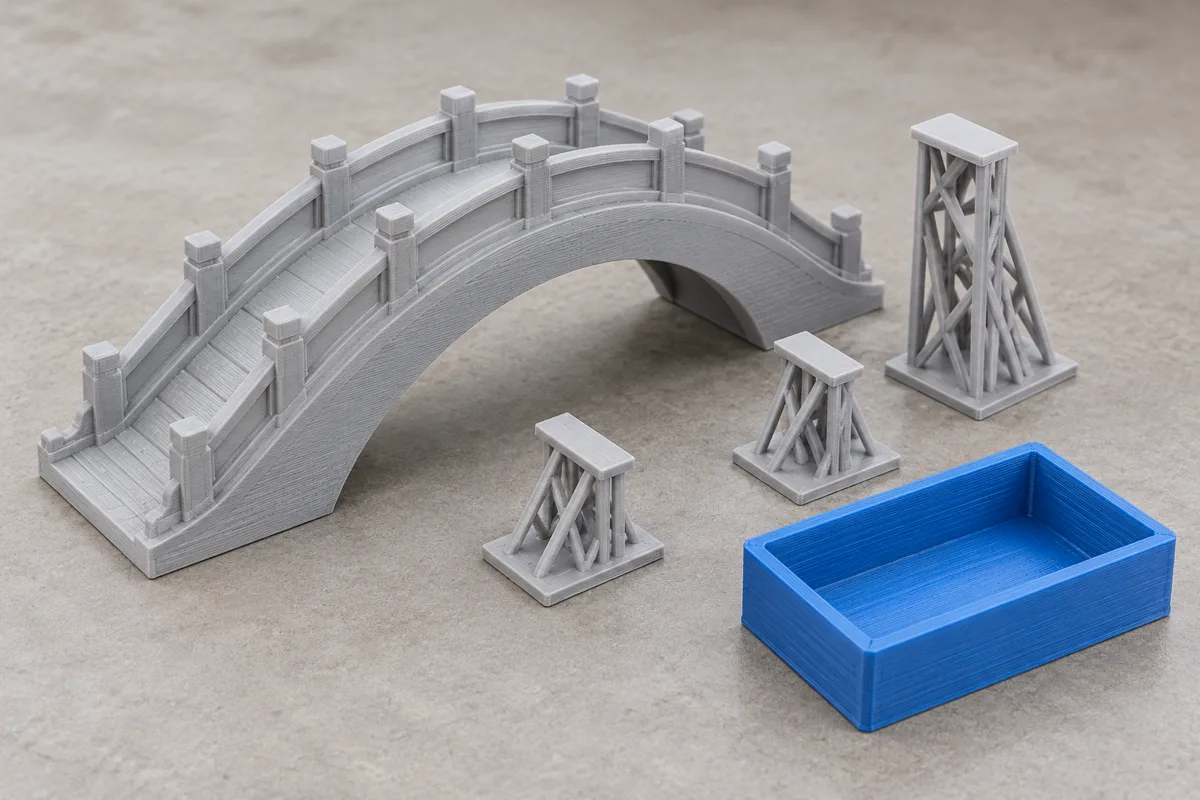
Open several files you actually expect to print in the correct slicer profiles. Check the complete job, not just the model’s longest dimension. Include a brim or supports when needed and inspect whether rotating the model changes its fit or support requirements.
Small clips, stands, miniatures, and organizers may fit either machine. A wider organizer or a larger prop section may favor the A1. The name of the object alone does not determine which printer it requires.
A model slightly beyond one nominal dimension might fit in another orientation, while an apparently small model may need extra room for supports. Do not use a blanket “under 180 mm” rule as a substitute for slicing.
Batches need their own check
A larger plate offers more area for arranging parts, but the batch count depends on their footprints, spacing, and printing mode. This review does not claim a fixed number of parts for either printer.
Compare representative sliced jobs at equivalent settings. Estimated time and material can help plan the work, but actual results would require measurement. A bigger batch is not automatically faster or cheaper than printing the same pieces across several jobs.
Workspace: allow for the moving bed and accessories
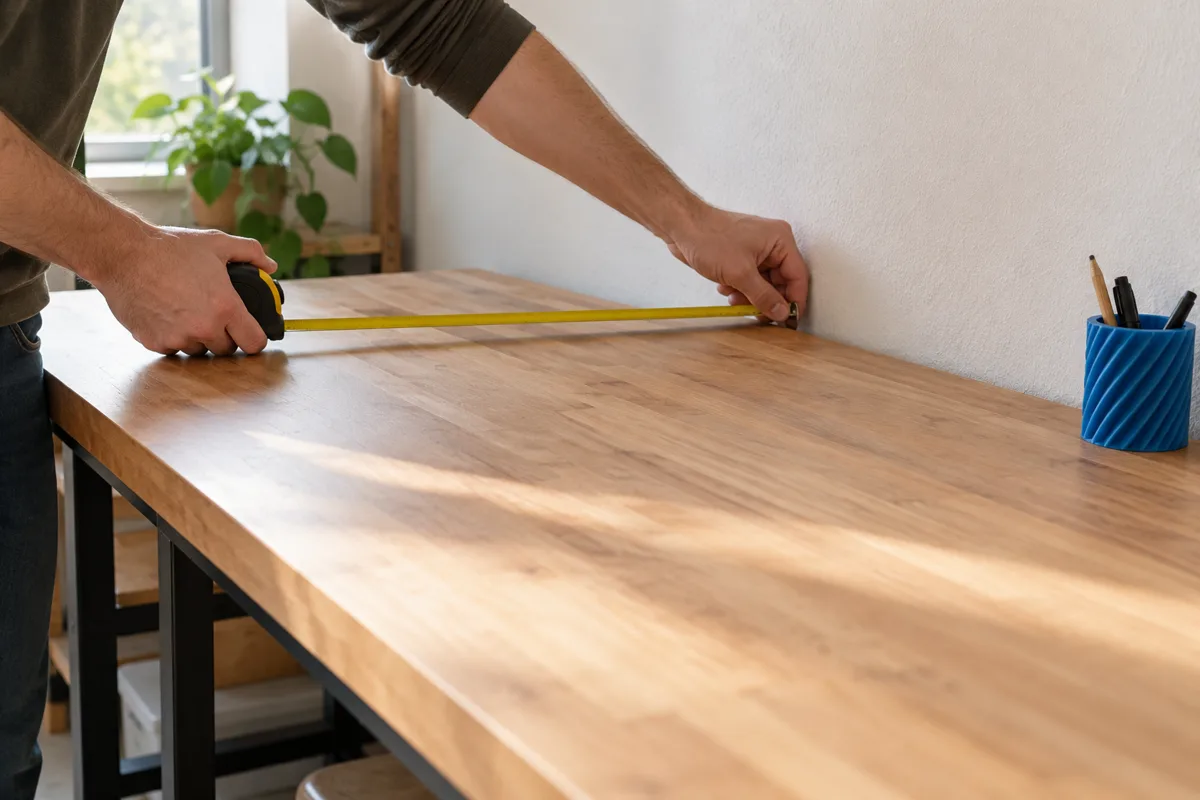
Both quick-start guides instruct users to leave space for heatbed movement. The static body dimensions do not describe the full operating area.
Measure depth as well as width. Include the moving bed, cable routing, spool access, build-plate removal, and maintenance reach. Use the setup diagram and instructions for the supplied unit rather than generic front-and-back clearance estimates.
If you add a material system, measure that arrangement separately. The AMS lite positioning illustrated in a Combo guide is not a complete workspace specification. Spools, tubing, and access can materially change the installation.
The mini’s smaller body may be helpful in a limited workspace, but a complete mini-and-accessory setup still needs measuring. Do not buy either printer based only on its product name or the area occupied by the base.
Materials and temperature differences
The reference guides list PLA, PETG, TPU, and PVA as ideal materials, and mark several higher-temperature or reinforced materials as not recommended. These categories are starting points, not guarantees for every formulation or feeding method.
The A1 has a higher listed maximum bed temperature. That does not prove better PETG adhesion for every spool, plate, or profile. Use the filament and build-surface instructions rather than selecting a bed temperature simply because the machine can reach it.
Check the exact filament and hardware
Bambu’s A1 product FAQ qualifies some high-temperature uses by model size, infill, ambient conditions, drying, and other settings. It also identifies hardened-nozzle requirements for abrasive fillers. Do not convert a reference “not recommended” category into a claim that a material is physically impossible to print.
Equally, a suitable hotend temperature does not establish that either printer is a dependable choice for a chamber-dependent process. Follow model-specific guidance and choose appropriate equipment when those requirements are central to your work.
The A1 FAQ does not recommend enclosing that printer. Do not treat a homemade enclosure as an approved way to expand material compatibility. Check the current guidance for the exact model rather than assuming the same modification is suitable for both.
Printer and feeder compatibility are separate
A filament listed for the printer is not automatically suitable for AMS lite or another feeder. The Combo guide cautions against flexible materials such as TPU in AMS lite and lists restrictions involving PVA and reinforced filaments.
Verify the specific filament, nozzle, drying requirements, and feed path before planning automatic support-material or multicolor work. An external-spool setup and an automatic switching setup can have different restrictions.
Base printer or Combo package?
The accessible reference Combo documentation describes an AMS lite arrangement with four spool positions. It does not establish the contents of every current US package.
Choose a single-spool configuration when it covers the projects you expect to print. Compare an appropriate switching package when automatic changes solve a recurring need. Include the complete equipment cost and operating space.
Do not assume AMS lite is the only current accessory path, or that another AMS unit connects directly. The current multi-model compatibility guide could not be retrieved during this check. Confirm the supported unit, hub or adapter, power equipment, firmware, and mixing restrictions directly with Bambu before ordering.
Account for switching time and purge material
Automatic changes on a single-nozzle setup can add loading, unloading, flushing, and prime structures. The effect depends on the model, color sequence, number of changes, and settings.
Inspect the sliced job’s estimates rather than relying on a universal waste percentage or print-time penalty. This comparison does not measure either. An open spool system should also not be treated as sealed storage or an active dryer.
Setup, software, and monitoring
The setup processes differ. The A1 guide describes assembling the frame and base, while the mini guide describes removing transport restraints and fitting components. Follow the supplied instructions; this comparison does not provide a tested setup-time estimate.
Both documented workflows use Bambu Studio, initial calibration, and the correct printer/material profiles. Automatic features do not remove the need to inspect the sliced job, maintain the machine, or troubleshoot a problem.
Bambu’s security white paper describes LAN-only and offline printing as alternatives to cloud operation. It also says Bambu Handy is not functional in LAN-only mode. Check the current firmware and software instructions for the features available through your chosen method.
The cameras are listed for monitoring and timelapse. Their resolution does not establish smooth video, reliable automated failure detection, or permission for unattended operation. Follow the manufacturer’s operating instructions.
Ownership costs and current US purchase details
The official A1 mini US listing and A1 US listing could not be retrieved on October 30, 2026. Current US prices, stock, promotions, bundle contents, and shipping costs remain unconfirmed. Check the selected package directly before buying; no fixed upgrade premium is assumed here.
Budget for filament, suitable replacement plates or nozzles, cleaning supplies, specified lubricants, and wear parts as needed. Add any accessory maintenance and switching material. Check what the package includes before buying duplicates.
Follow model-specific maintenance and filament storage instructions. Sealed storage with maintained desiccant is different from actively drying wet filament. Avoid buying equipment solely on the assumption that every user needs the same accessories.
A larger build area does not inherently make each part more expensive. It also does not guarantee savings. The actual geometry, print settings, waste, and complete purchase cost determine the comparison.
Buying a used A1: check the recall separately
The US CPSC notice dated June 13, 2024 covers affected A1 units sold from December 2023 through January 2024. It identifies them by an “A” in the sixth position of the serial number, on the rear QR-code label.
For recalled units, CPSC directs owners to stop use and contact Bambu Lab for a refund or a free heatbed-and-cable replacement through a local electronics repair facility. Consumers should not attempt the repair themselves.
For a used purchase, obtain the serial number and ask Bambu to confirm recall and remedy status. A cable protector or an undamaged appearance is not proof of a completed remedy.
Bambu’s historical cable announcement states that the A1 mini was not affected by that issue. Use the later CPSC notice for US affected-A1 remedy instructions, rather than the older announcement’s interim advice. This history does not establish that every current A1 is recalled.
Which one should you choose?
Consider the A1 mini when representative sliced projects fit and the complete installation suits your available space. Small-format projects are not automatically inferior or less useful, and there is no need to assume every buyer will outgrow the machine.
Consider the A1 when its build area accommodates specific larger parts or arrangements you expect to use. Check that its installation and complete cost are acceptable rather than choosing it because future needs are uncertain.
Compare a switching package when it serves a real workflow. Separate that decision from printer size; needing a bigger plate does not automatically mean needing multicolor equipment.
For more context, read our A1 mini review and beginner printer guide.
Sources and research method
Official quick-start guides, indexed manufacturer product information, Bambu’s security white paper, and the CPSC notice were checked on October 30, 2026. Reference documents may lag current hardware, software, and packages. The A1 dimension conflict is retained for verification; live US purchase details and the current AMS compatibility guide could not be confirmed. No owner-survey findings, personal testing, or measured performance results are claimed. Images are AI-generated conceptual illustrations, not test prints, exact scale comparisons, or product photographs.